

Table of Contents
If you were planning to buy a Nintendo Switch 2 at some point this year, buy it before Tuesday. Nintendo’s US price goes from $449.99 to $499.99 on September 1, and that’s not a rumour or a retailer promotion ending, it’s a confirmed change.
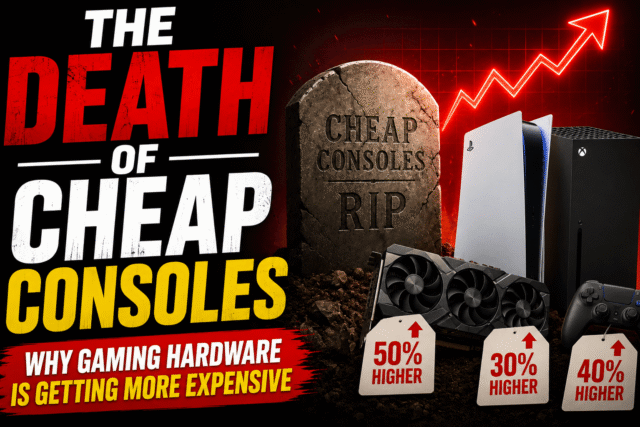
That’s the sharpest deadline in a year full of them. We’ve been tracking the memory shortage all year as it pushed up phones and laptops, and it has now arrived fully in the living room: Xbox consoles jumped by up to $150 on August 1, PlayStation 5 pricing has climbed repeatedly, and the era of consoles getting cheaper as they age is, for this generation, effectively over.
Here’s exactly what changed, why gaming hardware is getting hit harder than anything else, and how to shop the next four months without overpaying.
What Actually Went Up, and By How Much
- Xbox, effective August 1. Microsoft announced on June 25 that all 512GB models would rise $100 and all 1TB models $150, worldwide. The resulting US prices: Series S 512GB at $499.99, Series S 1TB at $599.99, Series X Digital at $749.99, and the disc-equipped Series X at $799.99. The 2TB Galaxy Black edition was discontinued rather than repriced past $900. For perspective, the Series X launched at $499.99 in 2020 and the Series S at $299.99, and this was Microsoft’s third increase since May 2025.
- Nintendo Switch 2, effective September 1. From $449.99 to $499.99 in the US, the console’s first change since its 2025 launch, with matching adjustments in other regions. Nintendo has been unusually direct in tying it to memory costs.
- PlayStation 5. Sony has raised prices across 2025 and 2026, with the base PS5 having climbed substantially from its $499.99 launch price, and the PS5 Pro sitting at $699.99. Reports suggest Sony secured memory supply into 2027, which may mean it holds prices through the holidays while competitors don’t, an unusual position for Sony to be the cheaper option.
- Everything adjacent. Valve’s Steam Machine launched at $1,049, well above where it was reportedly targeted, and handheld gaming PCs from Asus and MSI have seen similar pressure.
Why Consoles Get Hit Hardest
Microsoft’s own explanation is the clearest statement anyone in the industry has made about this crisis, and it’s worth quoting the mechanics: console storage and memory prices have increased more than 2.5 times, with the company expecting another doubling by the fall of 2027.
Then the structural part, which explains why consoles suffer more than phones or laptops: consoles are typically not sold at a profit, but for less than they cost to make, with the money recovered later through games and subscriptions. A phone maker facing higher memory costs can absorb some of it out of a healthy margin. A console maker selling at a loss already has no margin to absorb anything, so component increases pass straight to the sticker price.
That’s also why nobody sensible is predicting relief soon. AI data centre demand for memory is structural rather than a temporary spike, analysts point to 2027 or 2028 before supply loosens, and Sony has reportedly considered pushing the PS6 back as far as 2029 because building a next-generation console at an affordable price simply doesn’t work at current component costs.
Buy Now or Wait: The Honest Verdicts
- Switch 2: buy before Tuesday if you were buying at all. A confirmed $50 increase in three days is the rare case where urgency is real rather than manufactured. If it’s a holiday gift, buying now and hiding it in a cupboard saves fifty dollars for zero risk.
- Xbox: the increase already happened, so there’s no deadline to beat. The question now is whether $799 for a five-year-old console makes sense, and for most people the honest answer is no. Look at refurbished and second-hand stock instead, which Microsoft itself is actively promoting alongside financing options, or consider whether Game Pass on a device you already own covers what you actually want.
- PlayStation: the most stable option right now, and possibly the only major platform not raising prices before the holidays. If you’re choosing between ecosystems on price alone, that’s a genuine factor this year for the first time in a while.
- Gaming PCs and handhelds: wait unless you need one. Memory-heavy purchases are the worst category during a memory shortage, and the same logic we applied to laptops holds here.
- Anything with lots of storage or RAM in it: buy the configuration you need now rather than planning to upgrade later, because add-on memory and storage are precisely where prices have moved most.
How to Shop This Holiday Season
Expect bundles instead of discounts. With hardware margins gone, retailers are leaning on bundles, trade-in credit, and promotions rather than cutting console prices. A bundle with two games you actually want is this year’s version of a good deal; a straight price cut mostly isn’t coming.
Take last-generation and refurbished seriously. Manufacturer-certified refurbished consoles carry warranties, and this is the year that market makes obvious sense, though the same buying checks apply as with any refurbished hardware.
Don’t buy financing you don’t need. Interest-free plans are proliferating precisely because prices crossed a psychological line. They’re fine if you’d have paid cash anyway and want to spread it; they’re a trap if they’re the only way the purchase works.
Buy early for gifts. Between confirmed increases and shortage-driven supply constraints, the pattern this year favours buying in September and October rather than waiting for a Black Friday that may be thinner than usual.
Quick Answers
When does the Nintendo Switch 2 price go up?
September 1, 2026, from $449.99 to $499.99 in the US, with equivalent changes in other regions.
How much did Xbox prices increase?
On August 1, 2026, 512GB models rose $100 and 1TB models $150 worldwide, putting the Series X at $799.99 and the Series S at $499.99. The 2TB model was discontinued.
Why are console prices going up?
Memory and storage costs have more than doubled because AI data centres are consuming global supply. Consoles are hit hardest because they’re typically sold below cost, leaving no margin to absorb increases.
Will console prices come back down?
Not soon. Industry forecasts point to 2027 or 2028 before memory supply loosens, and Microsoft expects component costs to double again by late 2027.
Is PlayStation cheaper than Xbox now?
On current pricing, yes, which reverses most of this generation. Sony has reportedly secured memory supply into 2027, which may let it hold prices through the holidays.
The Bottom Line
The memory shortage that pushed up phones and laptops has now taken the living room, and consoles absorb it worst because they were never sold at a profit to begin with. Practically, that gives you one hard deadline and one general rule. The deadline: a Switch 2 costs $50 more from Tuesday, so buy it this weekend if it was on your list. The rule: this is a buy-early year, where bundles beat discounts, refurbished deserves a real look, and waiting for prices to fall means waiting until 2027 at the earliest. Nobody enjoys buying into a rising market, but on current forecasts, this holiday season is the cheapest one you’ll see for a while.