
Table of Contents
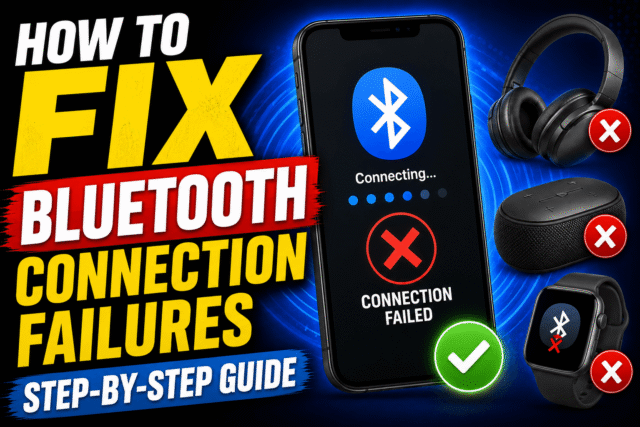
Your earbuds worked yesterday. Today your phone either can’t see them, sees them and refuses to connect, or says “connected” while producing complete silence. Bluetooth has a genius for failing in ways that feel personal.
Here’s the reassuring part: the overwhelming majority of these failures come down to three unglamorous causes, and none of them means broken hardware. The device isn’t actually in pairing mode. It’s already connected to something else in the house. Or the stored pairing record has gone stale and needs deleting. Work through them in order and most problems resolve in under five minutes.
The 60-Second Triage
Before fixing anything, find out which side is failing.
Test a second Bluetooth device with your phone. Connect anything else, another speaker, your car, a friend’s earbuds.
- Other devices connect fine → the problem is the accessory. Skip to the pairing-mode and device sections.
- Nothing connects at all → the problem is your phone or computer. Toggle Bluetooth off and on, then restart the device, which resolves a surprising share of cases outright. Check airplane mode is off, and on Android, try clearing the Bluetooth cache in app settings.
Then check the boring stuff, because it accounts for more failures than anything technical: is the accessory charged (dead batteries produce exactly these symptoms), is it within range, and is it actually powered on rather than merely sitting in a case?
The Thing Almost Everyone Gets Wrong
Two distinct concepts get confused here, and the confusion causes most “it won’t connect” frustration.
Pairing stores the relationship between two devices. Connecting is an active session. A device can be perfectly paired and simply not connected, which is why an accessory sitting in your Bluetooth list under “My Devices” isn’t necessarily talking to your phone. Tap it and choose Connect rather than assuming the list means it’s live.
And the single most common cause of a device refusing to connect: it’s already connected to something else. Modern headphones and speakers frequently support multipoint, holding connections to two or three devices at once, so your earbuds may have grabbed your laptop when you sat down, or your car may still hold your partner’s phone. If your earbuds are being stubborn, turn off Bluetooth on the other devices nearby and try again. This one fix probably resolves more cases than everything else in this article combined.
Getting into pairing mode is the other half. An accessory that’s powered on isn’t necessarily discoverable; it usually needs a deliberate action, typically holding the power or pairing button until an LED flashes, often in a distinctive colour or rhythm that differs from normal operation. For earbuds, this usually means both buds in the open case with the case button held for several seconds. If you can’t remember your device’s sequence, the manual is worth thirty seconds of searching, because guessing wastes far longer.
Forget and Re-Pair: The Reset That Fixes Most Cases
When a device pairs but misbehaves, the stored pairing record has usually gone corrupt. Deleting it and starting fresh fixes an enormous share of persistent problems.
Delete the record on your phone or computer:
- iPhone/iPad: Settings, Bluetooth, tap the (i) beside the device, then Forget This Device.
- Android: Settings, Bluetooth, tap the device name (or its gear icon), then Unpair or Forget.
- Windows: Settings, Bluetooth & devices, three-dot menu beside the device, Remove device.
- Mac: System Settings, Bluetooth, hover the device and select the option to forget it.
Then delete it on the accessory too, which is the step people skip and the reason re-pairing sometimes fails. Cars are the classic example: clear your phone from the car’s own infotainment list as well as clearing the car from your phone. Removing only one side leaves two systems trying to authenticate against a record only one of them still has.
Finally, put the accessory back into pairing mode and pair it as a new device.
If the accessory won’t enter pairing mode at all, it may have hit its limit on stored pairings. Most Bluetooth accessories remember a fixed number of devices, and once full, they stop accepting new ones. The fix is a factory reset of the accessory itself, which is device-specific and always in the manual.
The One-Earbud Problem
A category of its own, because the fix that works most often is one nobody checks.
Check the audio balance slider first. On iPhone: Settings, Accessibility, Audio & Visual, and confirm the Balance slider sits dead centre. On Android: Settings, Accessibility, then Audio balance. This gets nudged accidentally far more often than people realise, and it produces exactly the symptom of one earbud “not working” while both are connected perfectly.
If balance is centred, the buds have lost sync with each other. The reliable fix: put both earbuds in the case, close the lid for ten seconds, forget the earbuds on your phone, then factory-reset the earbuds per the manufacturer’s instructions. When you re-pair, take both earbuds out of the case together, in pairing mode at the same time. Pairing one bud first is the classic mistake that recreates the mono problem immediately.
Also worth checking: charging contacts on the buds and in the case. A single dirty contact means one bud quietly never charged, and a dead bud looks identical to a disconnected one. A dry cloth or cotton bud is enough.
Interference and the Limits of Physics
If connections work but drop or stutter, you’re likely fighting interference. Bluetooth shares the crowded 2.4GHz band with Wi-Fi, microwaves, and plenty of other wireless gear, which is the same congestion problem we covered from the Wi-Fi side.
Practical mitigations: keep the phone on the same side of your body as the earbuds (yes, really, since your body absorbs 2.4GHz signal effectively), move away from an operating microwave, don’t leave the phone behind a wall or a metal object, and if your router sits directly beside where you use Bluetooth audio, relocating one or the other genuinely helps.
Range is around ten metres in ideal conditions, and real walls cut that hard.
When It’s Genuinely the Hardware
If a device fails on multiple phones after a factory reset, it’s the device. If every accessory fails on one phone after a network settings reset, it’s the phone. Two things worth trying before writing anything off: update the accessory’s firmware through its companion app, since Bluetooth bugs are patched there routinely, and update your phone’s operating system for the same reason. And as a genuine last resort on the phone side, resetting network settings clears all Bluetooth pairings along with saved Wi-Fi passwords, which is a real cost, so keep it last.
Quick Answers
Why won’t my Bluetooth device connect even though it’s paired?
Pairing stores a relationship; connecting is a live session. It’s often already connected to another device nearby, so disable Bluetooth on your other devices and try again.
How do I put my earbuds in pairing mode?
Usually both buds in the open case with the case button held for several seconds until the LED flashes. The sequence varies by brand, so check the manual rather than guessing.
Why is only one earbud working?
Check the audio balance slider in Accessibility settings first. If it’s centred, the buds have lost sync: forget them, factory-reset them, and re-pair with both buds out of the case together.
Why does my Bluetooth keep disconnecting?
Usually 2.4GHz interference, distance, or your body blocking the signal. Move closer, keep the phone on the same side as the earbuds, and stay away from microwaves and crowded routers.
Does forgetting a device delete anything important?
Only that pairing. You’ll re-pair from scratch. Resetting network settings, by contrast, clears every pairing plus saved Wi-Fi passwords, so keep that as a last resort.
The Bottom Line
Bluetooth failures look mysterious and almost never are. Test a second device to find out which side is broken, then check the three usual suspects in order: is it charged and actually in pairing mode, is it already connected to a laptop or car you forgot about, and is the stored pairing record stale? Forget it on both sides and pair fresh, and you’ve fixed most of what goes wrong. Save the balance-slider check for one-sided earbuds, blame the 2.4GHz band for stuttering, and reach for a network settings reset only when everything else has failed and you’ve accepted losing your Wi-Fi passwords along with it.