
Table of Contents
Everything you learned about spotting fake reviews stopped working. Broken English, wild enthusiasm, five identical sentences in a row: those were the tells of an era when fake reviews were written cheaply by humans in bulk. Now they’re generated by language models, and they’re fluent, specific, plausibly detailed, and free to produce at any scale a seller wants.
So the game has changed in the same way it changed for spotting AI images: individual specimens are no longer reliably identifiable by eye, and the durable signals have moved from the writing to the structure around it. Here’s what actually works in 2026, including one manipulation most shoppers have never heard of, plus an honest answer about whether checker tools are worth using.
One disclosure first, because it shapes what you’ll read elsewhere: most guides ranking for this topic are published by companies selling fake-review detection tools, and they have an obvious interest in convincing you that you can’t do this yourself. You largely can.
Why the Old Tells Stopped Working
The single most useful mental adjustment: too-perfect writing is now itself mildly suspicious, and bad writing is not. Real customers type on phones, make typos, ramble, mention irrelevant details, and complain about the packaging. A review that reads like clean marketing prose with a tidy pros-and-cons structure is more likely to be synthetic than one riddled with errors.
But even that’s a weak signal on its own, which is the real point. Estimates of how much of the review pool is fake vary enormously depending on who’s counting and what they’re counting, from around 3% of front-page reviews flagged as AI-generated in one analysis to claims that roughly 30% of all online reviews are inauthentic. That spread should tell you something: nobody can reliably identify fakes one at a time, including the people selling detection. Patterns beat prose.
The Structural Signals That Still Hold
These are the ones worth learning, because they survive whatever the text looks like.
- Review velocity. A product that collected 400 reviews in three weeks, then almost nothing, is showing you a campaign rather than a customer base. Sort by most recent and look at the dates. Organic reviews accumulate steadily; purchased ones arrive in bursts.
- The rating distribution shape. Click the star breakdown. A healthy product shows a slope: lots of fives, a decent number of fours, a scattering below. A U-shape, meaning a pile of five stars and a pile of one stars with almost nothing between, often means the fives were manufactured and the ones are real customers arriving after the fact.
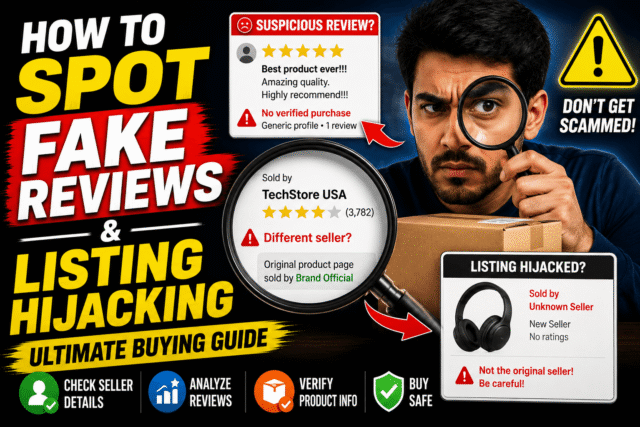
- Reviewer histories. Open two or three of the glowing reviewers. Accounts created recently, reviewing dozens of unrelated products in a short window, all five stars, no photos, is the profile of a review farm rather than a shopper.
- The four-star reviews. This is where the truth usually lives. Fake campaigns concentrate on five stars, and one-star reviews are often about shipping or a defective unit rather than the product itself. Four-star reviews are where real customers say “it’s good, but the strap is cheap and the app is bad,” which is exactly the information you came for.
- Verified Purchase, with a caveat. It’s a meaningful filter and it’s gameable, most notably through brushing, where sellers ship cheap items to real addresses to generate verified reviews. Treat it as a positive signal rather than proof.
Listing Hijacking: The Trick Nobody Knows
This is the one that catches even careful shoppers, because the reviews are completely genuine. They just belong to a different product.
Marketplaces let sellers group product “variations” together, and reviews follow the group. So an established listing with 3,000 glowing reviews for, say, a phone case can be edited to sell something else entirely, while keeping every review. Related tactics involve merging listings or abusing variation relationships so a brand-new item inherits an older product’s reputation.
The tell is in the review text. Scroll and read: if the reviews mention a different colour, size, model, or a completely different category of product than what you’re looking at, you’re looking at a hijacked listing. A “wireless earbuds” page whose reviews rave about a lovely phone case is not a page you should trust, and no star rating on it means anything.
Do Review-Checker Tools Work?
Partially, with honest caveats worth stating.
They analyse patterns faster than you can (account ages, timing anomalies, verified ratios), which is genuine value. But they’re detection tools chasing generation tools, which is a race the generators are currently winning, and the same accuracy problem we documented with AI image detectors applies here: a confident-looking grade is a probability estimate, not a verdict. Tools also come and go, with Fakespot, long the most-recommended free option, shut down after its acquisition by Mozilla, leaving a market where many replacements are paywalled or built on older detection assumptions.
My honest position: use one as a first-pass signal if you like, and never as the deciding vote. And be aware that a checker recommending you buy something is a business model, not an oracle.
The free alternative that consistently outperforms them: search the product name on Reddit or YouTube. Real owners discussing a product in a forum thread, or a video where someone handles the thing, tell you more in five minutes than a thousand reviews of unknown provenance.
Where Fake Reviews Concentrate
Risk isn’t evenly distributed, so calibrate your suspicion.
- Highest risk: cheap unbranded electronics, supplements and beauty products, phone accessories, and anything from a seller name that reads like a random string of capital letters. These categories are competitive, margins depend on ranking, and manufacturing reputation is cheaper than earning it.
- Lower risk: established brands, expensive items, and products with long review histories stretching back years.
This is also why the buying advice we’ve given elsewhere holds up: for refurbished phones, laptops, or anything substantial, buying from sellers with published standards and real return policies matters far more than any star rating, because a return window is a guarantee and a review is an assertion.
The 60-Second Pre-Purchase Check
For anything you’re about to buy:
- Check the distribution (10 seconds): star breakdown, looking for a U-shape.
- Sort by most recent (15 seconds): are reviews arriving steadily or in a burst?
- Read three four-star reviews (20 seconds): the honest complaints live here.
- Scan for hijacking (10 seconds): do reviews describe the product on the page?
- Open one reviewer profile (5 seconds): real history, or a fresh account reviewing forty things?
If two or more raise flags, search the product on Reddit before spending anything. And if you get burned anyway, reporting it to the platform and to the FTC genuinely matters, since complaint volume is one of the signals regulators use to prioritise enforcement.
Quick Answers
Are fake reviews illegal?
Yes in the US. The FTC’s Consumer Reviews and Testimonials Rule, effective October 2024, explicitly bans fake and AI-generated reviews, undisclosed insider reviews, and suppressing negative ones, with penalties above $50,000 per violation. Enforcement is by the FTC; consumers can’t sue directly.
Can you spot an AI-written review?
Not reliably one at a time, which is why patterns matter more than prose. Clean, tidy, marketing-style writing is now a mild flag rather than a mark of authenticity.
Does “Verified Purchase” mean a review is real?
It’s a useful filter, not proof. Brushing scams generate verified reviews by shipping cheap items to real addresses.
Do fake review checker tools actually work?
They spot patterns quickly but produce probability estimates, not verdicts, and detection lags generation. Useful as a first pass, never as your only check.
What’s the fastest way to sanity-check a product?
Read the four-star reviews and search the product name on Reddit. Between them, you’ll know within minutes.
The Bottom Line
Fake reviews got fluent, so stop reading them for tells and start reading the structure around them: the velocity, the distribution shape, the reviewer histories, and whether the reviews are even describing the product on the page. Spend your attention on the four-star reviews, where real customers explain what’s actually wrong, and treat detection tools as one opinion rather than a verdict. Sixty seconds of that beats any star rating, and it beats the tools built to sell you certainty in a domain where nobody has any.