

Table of Contents
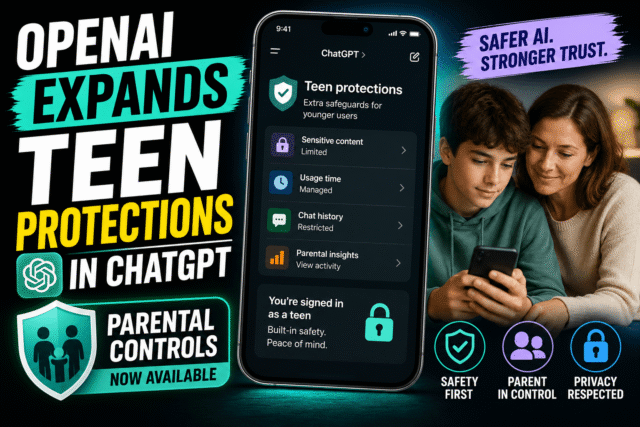
OpenAI is expanding its approach to teenage users of ChatGPT, introducing a more age-appropriate experience designed to give teens access to AI for learning and everyday use while adding stronger safeguards around sensitive content and interactions.
The move comes as AI tools become increasingly common among young people. OpenAI said nearly 9 in 10 teens using ChatGPT use it for learning, information, skill-building or productivity in a typical week, highlighting the growing role of AI in education and everyday activities.
ChatGPT Experience Designed for Teen Users
Rather than creating a completely separate AI model for teenagers, OpenAI’s approach applies additional protections to accounts identified as belonging to users under 18.
The company uses an age-prediction system that considers signals such as account activity, usage patterns, topics discussed, typical times of use and how long an account has existed. If ChatGPT predicts that an account belongs to someone under 18, it can automatically apply the teen experience.
The account remains active, but additional safeguards can be applied to sensitive or age-inappropriate content.
More Support for Learning
OpenAI has positioned teen use around learning rather than simply providing quick answers.
ChatGPT’s Study Mode is designed to guide students through a topic using explanations, questions and step-by-step reasoning rather than simply providing the final answer.
OpenAI has also continued expanding its education-focused tools. In August, the company introduced new education plugins designed to help K-12 teachers, college educators and students work with course materials and context inside ChatGPT Work and Codex.
Parents Can Manage Selected Settings
OpenAI’s parental controls allow parents or guardians to connect their account with a teen’s ChatGPT account and manage selected settings.
Parents do not normally get access to their teen’s conversations through parental controls. In limited circumstances involving serious safety concerns detected by OpenAI’s systems and trained reviewers, a parent or guardian may receive a notification containing information considered necessary to support the teen’s safety.
Parents can also manage certain features and settings, including periods when ChatGPT should not be available.
Additional Safeguards for Sensitive Topics
Teen accounts receive additional protections around subjects that may be inappropriate or harmful for younger users.
OpenAI says the teen experience can reduce exposure to areas including:
- Graphic violence or gore
- Viral challenges encouraging risky behaviour
- Sexual, romantic or violent roleplay
- Content promoting extreme beauty standards
- Unhealthy dieting and body shaming
The safeguards are intended to make ChatGPT more age-appropriate while allowing teenagers to continue using it for learning, creativity and general questions.
OpenAI has also been working with outside experts on youth safety. In August 2026, the company announced a partnership with the American Psychological Association focused on youth mental health and AI, including support for parents, caregivers and practitioners.
Age Verification Remains Available
Age prediction is not treated as a perfect system. If an adult is incorrectly placed into the teen experience, OpenAI allows the user to verify their age.
Age verification is handled through a third-party service. OpenAI says it does not receive the uploaded government ID or selfie itself. Instead, it receives information needed to establish the appropriate age experience.
OpenAI’s current help documentation says the third-party provider deletes uploaded ID or selfie information within seven days after verification.
Teen Protections End at 18
When ChatGPT determines that an account holder is 18 or older, the account can transition out of the teen experience.
At that point, teen protections are removed by default and the user gains access to the features and settings available to adult users. If parental controls were linked to the account, that connection ends when the account transitions to the adult experience.
A Shift From Blocking AI to Making It Safer
The broader direction of OpenAI’s policy is clear: teenagers are already using AI, so the focus is increasingly on making that use safer and more useful rather than simply preventing access.
OpenAI argues that AI can provide meaningful benefits to teenagers, particularly in education and skill development, while acknowledging that younger users need stronger safeguards than adults.
The challenge will be finding the right balance between useful access, privacy, parental oversight and protection from harmful interactions as AI becomes a more regular part of how teenagers learn and communicate.