
Table of Contents
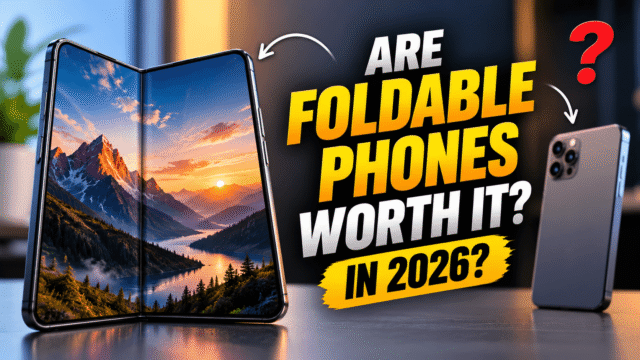
Apple unveils its first foldable iPhone on September 9, which means a category that spent seven years as an enthusiast curiosity is about to become a mainstream question. Millions of people who never considered a folding phone are about to consider one.
So here’s the honest assessment, free of both the manufacturer hype and the reflexive “it’ll break in a week” dismissal that’s been outdated for a couple of generations now. Foldables in 2026 are genuinely good, genuinely expensive, and genuinely not for everyone, and the deciding factors aren’t the ones the marketing emphasises.
What Foldables Genuinely Do Better
Two distinct products hide under one label, and they solve opposite problems.
- Book-style folds (Galaxy Z Fold, Pixel Pro Fold, and the incoming iPhone Duo) put a tablet in your pocket. The real-world payoff is multitasking that a slab simply can’t match: a document beside a browser, a video beside a chat, a map beside your notes. If you read a lot, work while commuting, or find yourself squinting at spreadsheets, the extra screen is a daily improvement rather than a party trick. Books and comics in particular are transformed.
- Flip-style folds solve the opposite problem: a normal-sized phone that halves into something that actually fits a small pocket. The secondary benefit people report most is behavioural, since a closed flip phone is less inviting to doom-scroll, which is a small but real intervention against exactly the engagement machinery we’ve written about.
What neither does better: cameras (the physics of a folding body limits sensor size and stabilisation compared to same-price flagships), battery (thin halves mean split, constrained cells), and weight. A book-style fold is noticeably heavier in a pocket than a standard phone.
The Durability Questions, Answered Honestly
The category’s reputation was set by the first generation and hasn’t caught up with the hardware.
- Hinges are largely a solved problem, mechanically. Manufacturers test to hundreds of thousands of fold cycles; Samsung rates its latest hinge at 500,000 folds, which is roughly thirteen years at a hundred opens a day, and Google markets its recent hinge as good for a decade of folding under its test assumptions. Those are lab numbers rather than warranties, but the practical point stands: you will not wear out a modern hinge by opening it.
- Dust resistance improved dramatically and still isn’t universal. Google’s Pixel Pro Fold carries a full IP68 rating, while Samsung’s Fold7 is rated IP48, meaning it resists water immersion but only blocks solid particles larger than a millimetre. Which matters more than the spec sheet suggests, for reasons in the next section.
- The inner screen is still the soft spot, because it has to bend. It’s a flexible panel under ultra-thin glass and a factory-applied film, which handles ordinary use fine but is more vulnerable than conventional phone glass to fingernails, sharp objects, and concentrated pressure.
Three rules follow, and they’re the ones owners actually need:
Never close the phone with anything inside it. Coins, keys, crumbs, or a card between the halves is the classic way to put a permanent dent in a folding display.
Never apply a normal tempered-glass protector to the inner screen. It can’t bend, and Samsung specifically advises against user removal of the factory film, directing owners to authorised service when it needs replacing. Peeling it yourself can void the screen warranty entirely.
Learn the real warning signs, which are not the crease: a sudden black line, spreading dead pixels, crackling sounds from the hinge, touch failures, or a protector that starts lifting at the fold.
The Crease: What It Actually Is
Yes, there’s a crease. Yes, it’s permanent. No, it’s almost certainly not what will bother you.
It’s a shallow valley where the display folds, most visible under harsh overhead light or at an angle, and largely invisible when you’re looking at content head-on. Most of its development happens in the first few months and then stabilises. Every owner I’ve heard from reports the same arc: distracting for a week, then genuinely forgotten.
The crease is a fault only if it’s accompanied by the warning signs above. On its own, it’s a design characteristic, and the internet’s obsession with it is disproportionate to how it feels in daily use.
Repair Costs: The Risk People Underestimate
This is the part that should actually shape your decision, and it’s financial rather than mechanical.
- The hinge, not the screen, is the real lifespan-decider. Everyone worries about folding wearing out the display, but the failure mode that ends foldables in practice is grit getting into the hinge: sand, pocket lint, metal filings, the fine debris of ordinary life working into a moving assembly that, on many models, isn’t fully dust-sealed. Out-of-warranty hinge repair has been reported at around $350 to $500. And here’s the compounding problem: because the inner display is bonded into the hinge assembly, a hinge repair frequently takes the panel with it, which is how owners end up looking at a four-figure bill on a phone they already paid a premium for.
- The screen alone is expensive enough. Samsung’s US service pricing lists inner-screen repair for the Galaxy Z Fold7 at around $449, with the smaller Z Flip7 around $249. Open-market parts pricing is starker: a genuine Fold7 foldable panel runs roughly €761 (about $890) for the part alone before labour, with the outer cover display around €525 (about $611). Compare that to $150 to $300 for a conventional flagship screen and the shape of the risk is obvious.
- Which makes the protection-plan math concrete rather than hand-wavy. Samsung Care+ for the Z Fold7 runs about $13 a month or $259 a year, and it drops cracked screen and back glass repairs to $29. Set that against a single out-of-warranty inner display at roughly $890 and the plan pays for itself with one incident inside about three and a half years. On a slab phone, protection plans are often a coin flip. On a foldable, given that the most expensive component is also the most exposed one, and the hinge failure mode can drag it along, the arithmetic genuinely favours the plan for anyone planning to keep the phone.
One practical caveat: repair pricing is regional. Check what a screen and a hinge actually cost in your country before buying, rather than trusting a US or EU figure.
The Price Premium, in a Bad Year for Premiums
Foldables have always carried a premium, and 2026 is a rough year to be paying one. The memory shortage we’ve been tracking all year has pushed prices up across phones, laptops, and consoles, and foldables sit at the top of the range where increases hurt most. Reported pricing for the newest book-style folds sits close to or above $1,900, and Apple’s entry is not expected to undercut anyone.
Which frames the honest question: for the price of a foldable plus its protection plan, you can buy an excellent conventional flagship and a tablet, with better cameras, better battery, cheaper repairs, and no hinge. The foldable’s case is that one device replaces two, in your pocket, all the time. That’s a real argument, and it’s a preference rather than a value calculation.
Who Should Buy One, and Who Shouldn’t
- Buy a book-style foldable if you genuinely multitask on your phone, read a lot, want fewer devices to carry, treat your phone carefully, and are willing to budget the protection plan as part of the purchase price rather than an optional extra.
- Buy a flip if pocketability is a real constraint in your life, or you want a phone that’s slightly harder to compulsively open.
- Skip foldables if you work around sand, dust, or metal particles, since that’s the hinge-ingress scenario that ends these phones early. Skip them too if you drop phones regularly, if cameras are your priority, if you keep phones five years or more, or if the price premium means stretching. A conventional flagship at the same money will be better at almost everything except folding.
- And if you’re intrigued but not convinced: first-generation hardware is where regret concentrates, which is worth remembering about Apple’s debut specifically. Waiting one generation, or buying a well-checked refurbished current-gen fold, gets you most of the experience with far less exposure.
Quick Answers
Do foldable phones break easily in 2026?
No, current models survive years of normal use, with hinges rated to hundreds of thousands of folds. The realistic risks are drops, grit entering the hinge, and pressure on the inner screen rather than folding itself.
What actually fails first on a foldable?
Hinge dust ingress is the most common lifespan-ending problem, and because the display is bonded into the hinge assembly, fixing it often requires replacing the panel too.
Is the crease noticeable?
Visible under angled light, largely invisible head-on, and most owners stop noticing within weeks. It’s permanent and normal, not a defect.
How much does it cost to fix a foldable screen?
Samsung’s service pricing runs roughly $449 for a Z Fold7 inner screen and around $249 for a Z Flip7, while genuine parts alone can approach $890 before labour, versus $150 to $300 for typical flagship screens.
Is Samsung Care+ worth it on a foldable?
The math says yes for most owners: about $13 a month or $259 a year, with $29 screen repairs, against an out-of-warranty inner display near $890. One incident inside roughly three and a half years pays for it.
The Bottom Line
Foldables graduated from experiment to legitimate product, and the durability fears that defined their reputation are mostly a generation out of date. What hasn’t changed is the arithmetic: you’re paying a significant premium in an already inflated year, accepting weaker cameras and battery, and taking on a repair profile where the hinge can quietly take a $900 display with it. That’s worth it if the folding form genuinely changes how you use a phone every day, and it’s an expensive novelty if it doesn’t. Budget the protection plan as part of the price, be honest with yourself about which user you are, and if you can’t tell, that’s your answer to wait a generation.