
Table of Contents
You and your neighbour open the same app on the same morning. Same news event, same platform. You see one framing of the story. They see a completely different one. Neither of you chose this, and nothing about it is random.
Every time you unlock your phone, a ranking system trained on billions of data points is deciding, in a fraction of a second, what lands in front of your eyes. Not because it favours a political side. Because it’s optimised for something simpler and far more consequential: keeping you engaged. And in the last couple of years, peer-reviewed research has measured exactly what that optimisation does to what you believe is normal, true, and worth being angry about.
Here’s how the machinery actually works.
Two Different Systems Are Working on You at Once
People tend to lump everything on their phone into one scary word, “the algorithm.” In reality, two separate systems get confused with each other, and the distinction matters.
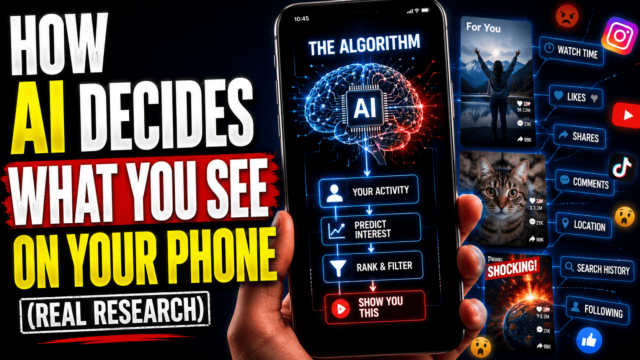
The first is content ranking. This is the system deciding the order of posts in your feed, which headlines a news app surfaces, which video autoplays next. It’s trained on your own history, meaning what you’ve tapped, how long you’ve lingered, what you’ve shared, and it predicts what will keep you scrolling for one more swipe.
The second is Real-Time Bidding, or RTB. This is advertising technology, and yes, it’s real: in under 100 milliseconds, advertisers bid against each other for the right to show you a specific ad based on data about who you are. It happens at absurd speed, and it deserves scrutiny. But RTB decides which advertisement you see. It is not the system choosing which news story appears in your feed. Both run on your data, but they’re separate auctions, and conflating them overstates what’s happening.
The system that actually shapes what you believe is the first one, content ranking. And that’s where the research gets uncomfortable.
What the Research Actually Found
The Twitter audit that measured it directly
In March 2025, a preregistered algorithmic audit published in the journal PNAS Nexus tested how engagement-based ranking behaves compared to a plain chronological feed. The finding: relative to a reverse-chronological baseline, Twitter’s engagement-based ranking algorithm amplified emotionally charged, out-group hostile content that users themselves said made them feel worse about their political opponents.
Sit with that for a second. The algorithm wasn’t neutrally showing people what they wanted. It was measurably serving more of the content that made people feel worse about the other side, because that content generated more clicks, replies, and shares.
The study contained a second finding that gets less attention and deserves more: users did not actually prefer the political posts the algorithm selected for them. The system was winning on engagement metrics while losing on what people said they wanted to see. It did its job perfectly. Its job just wasn’t your satisfaction.
The TikTok numbers from a real election
A separate study examined 25,292 TikTok videos posted by German politicians in the run-up to the 2025 German federal election, and put hard numbers on the same pattern. Videos expressing hostility toward opposing groups earned 49.3% more likes, 79.2% more comments, and 56.6% more shares than videos without it. Meanwhile, videos with positive sentiment received about 11% fewer likes and 15% fewer shares than the rest.
Being positive on the platform was, statistically, a penalty. And ideologically extreme parties on both ends of the spectrum both posted more of this divisive content and gained more engagement from it than centrist parties did.
Neither study claims platforms deliberately set out to spread anger. What they demonstrate is structural. Build a system whose core objective is “maximise time spent and interactions,” place it in front of a species whose attention responds more strongly to outrage than to calm information, and the system will learn to serve the outrage. Not because anyone told it to. Because the outrage works.
Why Nuance Loses the Ranking
This also explains why careful journalism struggles against a simplified, emotionally loaded headline covering the exact same story.
Ranking algorithms train on measurable signals: clicks, watch time, shares, comments. A nuanced investigative piece asks for two minutes of your attention and rewards you with an accurate picture of a genuinely complicated situation. An outrage headline compresses the same story into one sentence that triggers a reaction before you’ve finished reading it. The outrage version gets the instant click. It gets shared faster, because sharing something that confirms an emotion requires no deliberation.
Then the feedback loop kicks in. Content that performs well gets shown more. Getting shown more generates more engagement. More engagement convinces the algorithm this is exactly the kind of content to keep surfacing. Round and round, with no conspiracy required. Just an algorithm hitting the metric it was given, in a world where conflict captures attention more reliably than context.
What This Does to Your Picture of the World
Scale this up to billions of users making billions of daily interactions and you get the real consequence. Two people with different scroll histories end up with meaningfully different pictures of what’s happening in the same world, on the same day. That’s the answer to the neighbour question at the top of this article. Neither of you is being deliberately deceived. The algorithm learned, separately from each of your histories, what would keep each of you scrolling. And outrage, reliably, keeps people scrolling.
There is a hopeful thread. Researchers are actively working on what’s been called prosocial ranking, alternative systems designed to reduce the amplification of divisive content without abandoning engagement entirely. The Twitter audit itself found that a ranking tweak which demotes hostile content satisfied users’ stated preferences just as well while greatly reducing the amplification of divisive content. The open question is whether platforms adopt anything like it at scale.
How to Scroll Smarter Starting Today
You don’t need to quit social media to blunt this effect. A few things genuinely help.
Switch to chronological feeds where the option exists. Most major platforms now offer a “Following” or “Latest” view, and everything above explains why it feels calmer.
Notice the three-second fury. When something enrages you almost instantly, treat that speed as information. Genuine outrages usually survive a minute of thought. Manufactured ones often don’t.
Starve the loop deliberately. The ranking system reads your pauses as votes. Lingering on rage-bait, even to hate-read it, tells the algorithm to bring you more.
Follow sources that bore you slightly. A feed with some dry, careful reporting in it recalibrates what the system thinks you want.
Quick Answers
Is the algorithm politically biased?
The research says the bias is toward whatever generates engagement, and hostile content from both political extremes benefits. The measured favouritism is emotional, not partisan.
Does turning off personalisation fix it?
It helps. Chronological feeds remove the engagement-ranking layer, though they can’t change what the accounts you follow choose to post.
Are ads and my feed controlled by the same system?
No. Ads run through real-time bidding auctions. Your feed order comes from a separate content-ranking system. Both use your data, but they’re different machines.
Why does my feed feel angrier than my real life?
Because anger is overrepresented by design. Hostile content earns dramatically more engagement, so ranking systems surface more of it than a neutral sample of reality would contain.
The Bottom Line
The algorithm on your phone isn’t malicious and doesn’t hold opinions. It’s maximising a number, your engagement, and it has learned from watching billions of people that anger moves that number better than almost anything else. Understanding this won’t make your feed neutral. But the next time something makes you furious within three seconds of opening an app, you’ll know the right question to ask: is this outrage because the situation warrants it, or because outrage is exactly what the system was built to find and hand you first?