

Table of Contents
Let’s start with why this article can’t be a list of specific scam messages: the messages change weekly. Generative AI now writes flawless, persuasive scam scripts in any language, clones a bank’s tone perfectly, and localizes the con into Hindi, Hinglish, Spanish, or whatever your region speaks, in seconds. The old advice about spotting bad grammar is officially dead.
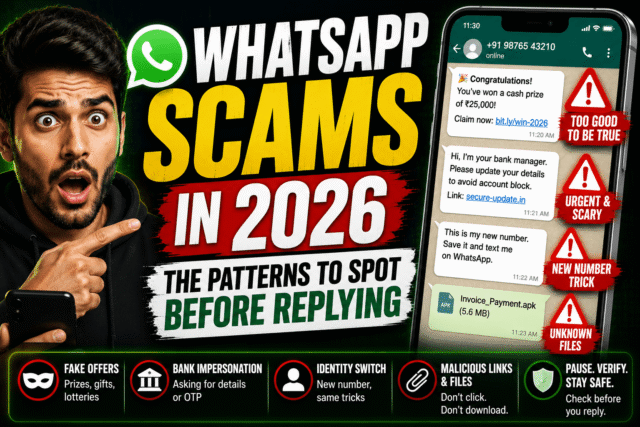
What doesn’t change is the shape underneath. Nearly every WhatsApp scam, and Meta removed 6.8 million accounts tied to organized scam operations in just six months, runs on a handful of patterns that stay constant while the words on top mutate. Learn the patterns and you’re protected against next month’s scripts too, which is the whole point of this guide.
Why WhatsApp Is the Scammer’s Favorite App
Three reasons, and none of them are flaws in the app itself. Nearly three billion people use it, so any number a scammer messages probably has an account. It’s private, so unlike a public social post, nobody else sees the con unfolding to warn you. And it’s where your family talks, which means a message there borrows an intimacy that an email never had. Scammers increasingly start elsewhere, a job ad, an SMS, a QR code on a flyer, and funnel you into WhatsApp precisely because it’s quiet in there.
The Five Patterns Behind Every Scam
- Pattern 1: A believable story attached to one small action. Every scam, whatever its costume, ends by asking you to do one specific thing: tap this link, pay this small fee, share this code, install this app. The story exists only to make that small action feel reasonable. Train yourself to spot the moment a message pivots from story to action, because that pivot is the trap closing, and urgency (“account blocked today,” “offer expires in an hour”) is the pressure applied to stop you thinking at exactly that moment.
- Pattern 2: The wrong number that becomes a friendship. “Hey, are we still on for dinner?” from a stranger, followed by charming apology and continued chat. This is the opening move of long-game investment fraud, the kind the FBI calls pig butchering: weeks of friendship, then casual mentions of investing, then a special trading app where your balance climbs beautifully on a dashboard that is entirely fake, until the day you try to withdraw and discover the exit costs a “fee.” The scale is staggering: one FBI operation alone reached nearly 9,000 victims and headed off an estimated $562 million in losses as of this April. The tell isn’t the wrong number; it’s a stranger who keeps talking and eventually steers toward money.
- Pattern 3: The dream job with an entry fee. Earn $250 to $500 a day, minimal hours, they found your resume, big brand name attached. Research into these operations shows they mass-message enormous lists and treat any reply as a live victim, and the mechanics always converge on the same thing: pay a registration fee, a training deposit, or a “task unlock” to receive money that never comes. A real employer never charges you to be hired. That single rule deletes this entire category.
- Pattern 4: The loved one on a new number. “Hi Mum, I lost my phone, this is my new number, I need money urgently.” It works because it stacks love, panic, and plausibility. The defense is boringly reliable: contact the person on the number you already have for them, by voice, before a single rupee or dollar moves. Which matters more than ever, because of what’s in the next section.
- Pattern 5: The official who slides into your DMs. Your bank demanding KYC verification through a link, a delivery company collecting a customs fee, WhatsApp “support” needing to verify your account, or, in the business version, a CEO messaging finance for an urgent transfer. The constant: real institutions don’t conduct urgent account actions through WhatsApp messages, and support teams never initiate contact there. When in doubt, close the chat and go to the official app or website you type in yourself, never the link you were sent.
The One Code You Must Never Share
This deserves its own section because it’s how accounts, not just money, get stolen. When WhatsApp registers your number on a device, it texts a six-digit verification code. If anyone, and I mean anyone, a friend whose account was hijacked, “WhatsApp support,” a family member’s new number, asks you to send them a six-digit code that just arrived on your phone, that request is the attack. Sharing it hands your entire account to a stranger, who then runs Pattern 4 on everyone you know, from your name.
Two 2026 variants of the same theft are worth knowing. One uses a fake photo or link that quietly walks you into approving a linked-device session, letting an attacker read your chats invisibly. The other happens on a phone call, where a “support agent” has you dial a code starting with * or #, which secretly forwards your calls, including verification calls, to the attacker. Never dial codes strangers dictate, and check Settings, then Linked devices occasionally for sessions you don’t recognize.
AI Voice Clones: The Family Scam’s Upgrade
The family-emergency scam now sometimes arrives as a voice, and the voice sounds genuinely like your daughter, because a few seconds of audio scraped from social media is enough to clone one. High-profile cases, including cloned voices of prominent Indian business figures used in fraud attempts, have proven this is operational, not theoretical.
The defense costs nothing: agree on a family code word, something never posted online, and make sure everyone from grandparents to the youngest phone-owner knows it. A cloned voice can reproduce everything about someone except the word they’ve never said on the internet. Pair that with the always-verify rule, calling back on the number you already have, and this scam dies at your doorstep.
What to Do If You Already Replied (or Paid)
No shame here; these operations are industrial and polished, and being busy is not being stupid. Move fast in this order.
If you shared a code or suspect account takeover: open Settings, Linked devices, and log out of everything. If you’re locked out entirely, reinstall WhatsApp and register with your number, which kicks the attacker’s session. Then set (or reset) your two-step verification PIN immediately, and warn your contacts by voice from a known number, because the attacker’s first move is scamming them as you.
If you paid: contact your bank or payment provider immediately, since fast reporting is the difference between reversible and gone. Report and block the scammer inside WhatsApp (tap the name, then Report). Then file with your national cybercrime channel: in India, the 1930 helpline and the national cybercrime portal; in the US, the FTC and the FBI’s IC3. And expect a follow-up scam: “recovery agents” who contact victims offering to retrieve lost money for a fee are the same criminals making a second pass.
Locking Down Your Account in Five Minutes
Do these today, in this order. Turn on two-step verification (Settings, Account) with a PIN you use nowhere else, plus a recovery email; this blocks most takeover paths even if a code leaks. Set your profile photo and personal details to contacts-only, which starves impersonators of material. Enable silencing of unknown callers to cut scam calls off before they start. Set the family code word tonight. And apply the same protective thinking to the accounts around WhatsApp, which is exactly the ground we covered in switching your logins to passkeys.
Quick Answers
- How do I know if a WhatsApp message is a scam?
Watch for the pivot from story to a small action: a link, a fee, a code, an app install, wrapped in urgency. That structure, not the story’s topic, is the tell. - What happens if I share my WhatsApp verification code?
An attacker registers your account on their device and impersonates you to everyone you know. Never share a six-digit code with anyone, for any reason. - Why did a stranger text me the wrong number and keep chatting?
It’s the scripted opening of long-game investment fraud. The friendship is the product; the fake trading app comes later. Stop replying. - Are messages with perfect grammar safe?
No. AI now writes flawless scam messages in any language, so polish means nothing. Judge the request, not the writing. - Can I get scammed just by receiving a message?
Receiving is harmless. The danger begins when you tap links, dial dictated codes, share codes, or pay. Report and block without engaging.
The Bottom Line
You don’t need to memorize this year’s scam scripts, because the scripts are disposable and the patterns aren’t. A story that ends in one small urgent action. A stranger who becomes a friend who becomes an investment tip. A job that charges you. A loved one on a new number. An institution doing official business in a chat app. Learn those five shapes, guard the six-digit code like it’s your account itself, set the family code word tonight, and switch on two-step verification before you put your phone down. The scammers’ tools got dramatically better this year. The defenses, honestly, are still the same five minutes they always were. On regular calls, India’s CNAP now shows the caller’s registered name