
Table of Contents
If you’ve installed an APK from outside the Play Store in the last year, you’ve probably also seen the headlines claiming Google is killing sideloading. The truth is messier than the outrage and more serious than Google’s reassurances. The rules genuinely are changing, the first enforcement date is now locked in for September 30, 2026, and a new system service that will do the enforcing is quietly installing itself on Android phones right now.
I’ve gone through Google’s official documentation and the rollout details published in June to give you the plain-language version: what’s actually changing, when it reaches you, what still works afterward, and what’s worth doing before the switch flips.
What Google Announced, in Plain Language
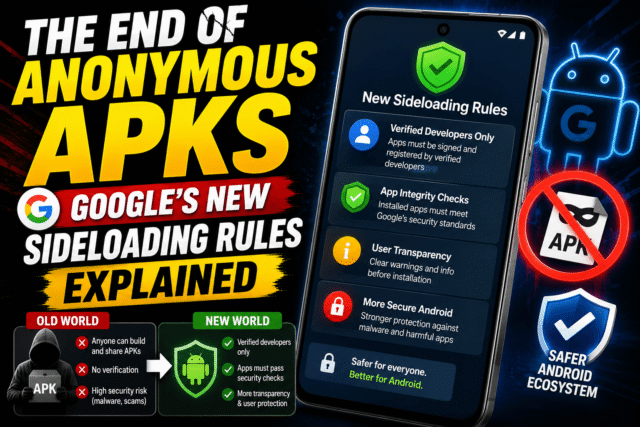
Google is introducing developer verification for Android. The rule: apps installed on certified Android devices, meaning virtually every phone that ships with Google’s services, must come from a developer who has registered their identity with Google. That applies to apps from the Play Store, apps from other app stores, and apps you sideload from a website.
Registering means handing Google a legal name, address, email, and phone number, with organizations also providing a D-U-N-S business number and possibly government ID. The point is accountability: malware distributors have historically operated through anonymous throwaway accounts, getting banned and reappearing under new names the next day, and Google’s justification leans on its claim that internet-sideloaded sources carry over 50 times more malware than Play Store downloads.
What this is not, despite the headlines, is a ban on sideloading. Google has been repeatedly explicit that installing apps from outside the Play Store remains possible. What changes is that anonymous apps face new friction.
The Actual Timeline and Countries
Here’s the schedule as it stands in July 2026, and if you’re reading this on an Android phone, part of it already involves you.
- Now: A background service called Android Developer Verifier is rolling out to devices running Android 8 or newer through Google System Updates, installing automatically. It sits dormant for the moment; its future job is checking whether an app’s developer is registered before allowing installation. Developer registration itself has been open since March, and Google says over 99% of apps have already been registered.
- August 2026: Two user-relevant pieces launch globally: the free limited-distribution account for students and hobbyists, letting them share apps with up to 20 devices without a government ID, and the “advanced flow” that lets power users keep installing unverified apps.
- September 30, 2026: Enforcement begins, but only in Brazil, Indonesia, Singapore, and Thailand, covering installs through Google Play, Samsung Galaxy Store, Xiaomi GetApps, HONOR App Market, OPPO App Market, vivo V-Appstore, and Palm Store.
- 2027: After a feedback period, the requirement expands globally to all certified Android devices.
So if you’re outside those four countries, nothing visibly changes for you this year. The global wave comes in 2027, and its exact dates aren’t set yet.
What Still Works After the Change
More than the panic suggested, honestly.
Verified apps install normally, from anywhere. A registered developer can distribute through any store or their own website, and those installs proceed as they always have.
Unverified apps remain installable through two doors. The first is ADB, the Android Debug Bridge, which continues to work for installing anything, though it requires a computer and developer settings. The second is the advanced flow arriving in August: a deliberate, one-time setup where you acknowledge the risks, after which you can install apps from unverified developers. Google designed it with friction on purpose, including reported waiting-period checkpoints, specifically so that scammers coaching a panicked victim over the phone can’t rush them through it. Annoying for you, and genuinely aimed at a real problem: phone-scam coercion is a documented epidemic, with one 2025 industry survey putting global consumer scam losses at $442 billion.
Custom ROMs and uncertified devices sit outside the system entirely. The requirement applies to certified Android devices. Flash a Google-free ROM and these rules don’t reach you.
What Changes, Honestly
The anonymous double-click APK install dies in enforced regions. Today, installing an unknown APK means tapping through a warning. After enforcement, an app from an unregistered developer won’t install through the normal path at all; it’s the advanced flow or ADB or nothing.
Small and hobbyist developers get squeezed toward Google’s paperwork. The 20-device limited account is a real concession, but anyone distributing beyond that must verify, and every app you install in the future will trace back to an identity Google approved. That’s the philosophical shift critics object to: open distribution on Android now runs through Google’s registry, and Google gains, in effect, a veto over who may distribute Android software widely, even entirely outside its store.
And the open-source ecosystem still has unanswered questions, which brings us to the elephant.
The F-Droid Question
F-Droid, the long-running open-source app store, builds many of its apps from source code itself, which sits awkwardly with a system requiring each app to be registered by its verified developer. F-Droid has publicly argued the verification model threatens how it operates, and as of this writing there’s no announced arrangement that cleanly resolves it. The practical reading for users: F-Droid works normally today everywhere, keeps working in unenforced regions through 2026, and its situation in the enforced future likely depends on the advanced flow, ADB, or concessions Google hasn’t made yet. If you rely on it, that’s the storyline to watch between now and 2027.
What to Do Before Enforcement Reaches You
- If you’re a regular user who occasionally sideloads: nothing urgent. Your existing apps keep working; the rules govern new installs and updates. When the advanced flow launches in August, set it up once if you want to keep your options open.
- If you sideload regularly: learn the ADB basics now, while there’s no pressure. It’s a fifteen-minute skill, it’s the one path Google has committed to leaving fully open, and it doubles as the escape hatch for anything the advanced flow complicates. Our offline AI guide already walks through a sideload of exactly this kind for MLC Chat.
- If you’re in Brazil, Indonesia, Singapore, or Thailand: treat September 30 as real. Anything you sideload from small or anonymous developers, grab updates and note the sources now, and expect the advanced flow to become part of your routine.
- Everyone: the golden rule that predates all of this still stands. The overwhelming majority of sideloading harm comes from downloading APKs from random mirror sites, something we’ve warned about before in the context of fake settings apps. Verification or not, stick to developers’ official channels.
Quick Answers
Is Google banning sideloading in 2026?
No. Unverified apps face new friction, but sideloading continues through the advanced flow and ADB, and verified developers can distribute outside the Play Store freely.
When do the new rules start?
September 30, 2026 in Brazil, Indonesia, Singapore, and Thailand. Globally in 2027, with exact dates not yet announced.
Will my already-installed apps stop working?
No. Enforcement concerns installing and updating apps, not apps already on your phone.
What is Android Developer Verifier on my phone?
Google’s new system service, delivered via Google System Updates to Android 8+ devices, that will perform the registration checks. It’s dormant until enforcement activates in your region.
Does this affect F-Droid?
Not yet in practice, but F-Droid has publicly warned the model threatens its way of operating, and its long-term situation is unresolved. Watch this one.
The Bottom Line
Android sideloading isn’t dying in 2026, but it is being renovated, and the anonymous era of it is ending. For most people the change will be invisible: their apps come from verified developers already. For tinkerers, the paths stay open at the cost of a one-time setup or an ADB cable. The real stakes sit with small developers, modders, and projects like F-Droid, whose fate in this system is still being negotiated. Enforcement starts in four countries this September and reaches everyone in 2027, which means the smartest thing you can do costs nothing: set up the advanced flow when it arrives, keep your sideloaded apps updated from official sources, and watch how the first wave actually plays out.